Trusted Canadian Immigration Lawyers
If you’ve ever filled out an immigration application, opened a Canadian bank account, or shipped a package across the country, you’ve used a postal code. It’s a small string of letters and numbers, but it carries a surprising amount of information, and getting it right matters more than most people realise.
Canada doesn’t use “ZIP codes” the way the United States does. Instead, it uses postal codes: six-character alphanumeric strings that pinpoint a delivery location with remarkable precision.
While a single U.S. ZIP code can cover tens of thousands of addresses, a Canadian postal code often narrows things down to one side of a single street. That precision is exactly why the system feels complicated at first, and why it’s worth understanding.
This guide breaks down what a Canadian postal code is, how its format works, and which prefixes belong to each province and territory.
A Canadian postal code is a six-character code made up of alternating letters and numbers, written in the pattern A1A 1A1 (letter-number-letter, a space, then number-letter-number). The space in the middle isn’t decorative; Canada Post requires it, and automated sorting equipment relies on it.
The system is managed by Canada Post, the country’s national mail carrier. Because postal codes are so specific, there are a lot of them. As of the last published count, Canada had roughly 876,445 active postal codes, ranging from A0A in Newfoundland and Labrador all the way to Y1A in Yukon. By comparison, the U.S. operates with only about 42,000 ZIP codes, which gives you a sense of how granular the Canadian system is.
Canada’s format puts it in good company. The postal codes of the United Kingdom, Ireland, and the Netherlands are also alphanumeric, mixing letters and digits rather than relying on numbers alone.
Every Canadian postal code splits cleanly into two halves, each doing a different job.
The first three characters (the part before the space) make up the Forward Sortation Area, which identifies a general region.
So, in a code like M5V 3L9, the “M5V” tells the system you’re dealing with an urban area in downtown Toronto before a single piece of mail is sorted further.
The three characters after the space form the Local Delivery Unit. This is where the precision comes in. An LDU can represent a single address, one side of a city block, a large apartment or office building, or a high-volume recipient such as a university or government office that receives heavy mail traffic. In rural areas, the LDU may cover a small community on its own.
Postal codes always use uppercase letters, and not every letter in the alphabet is in play. There are two rules worth remembering:
D, F, I, O, Q, and U. They’re excluded because they can be mistaken for numbers or other letters by optical scanning equipment, which would create sorting errors.
Although they can appear elsewhere in the code (a perfectly valid code might end in a Z, for example). That leaves 18 letters in active use for the leading character. It’s a common mistake to assume W and Z are banned entirely; they aren’t, they just can’t lead.
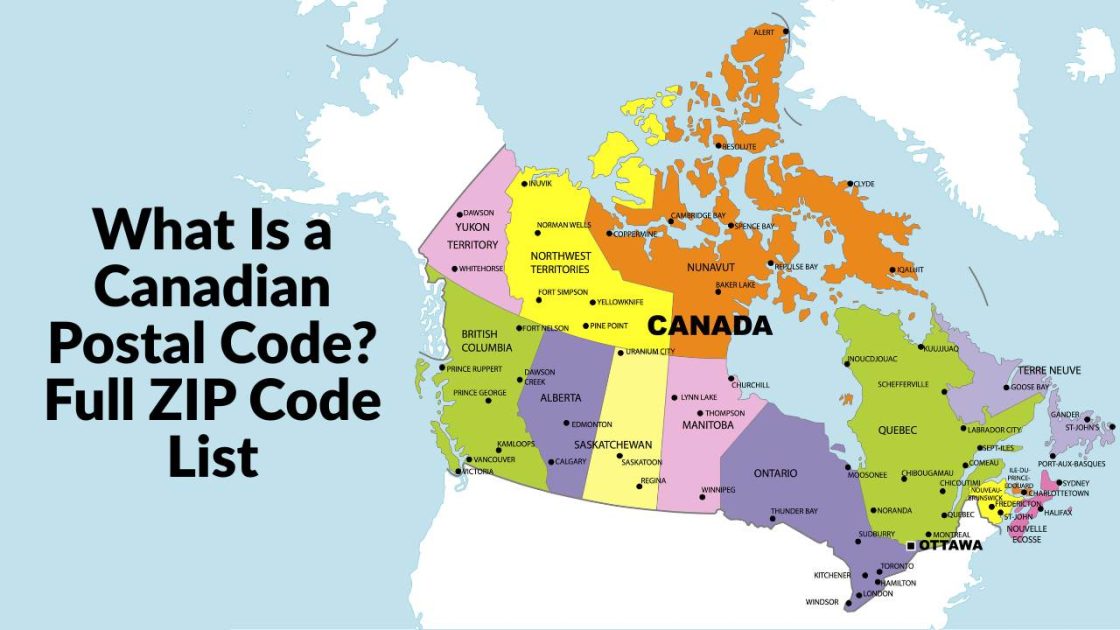
The first letter of a postal code maps to a province or territory, moving generally from the east coast to the west, with the northern territories at the end of the alphabet. Here’s the full breakdown:
|
Province / Territory |
First-Letter Prefix(es) |
Example FSA |
|
Newfoundland & Labrador (NL) |
A |
A1A — St. John’s |
|
Nova Scotia (NS) |
B |
B3J — Halifax |
|
Prince Edward Island (PE) |
C |
C1A — Charlottetown |
|
New Brunswick (NB) |
E |
E3B — Fredericton |
|
Quebec (QC) |
G, H, J |
H3A — Montreal, G1A — Quebec City |
|
Ontario (ON) |
K, L, M, N, P |
M4B — Toronto, K1A — Ottawa |
|
Manitoba (MB) |
R |
R3C — Winnipeg |
|
Saskatchewan (SK) |
S |
S4P — Regina |
|
Alberta (AB) |
T |
T2P — Calgary, T5J — Edmonton |
|
British Columbia (BC) |
V |
V6B — Vancouver, V8W — Victoria |
|
Northwest Territories (NT) |
X |
X1A — Yellowknife |
|
Nunavut (NU) |
X |
X0A — Iqaluit |
|
Yukon (YT) |
Y |
Y1A — Whitehorse |
Note that the larger provinces need several leading letters to cover their populations. Ontario alone uses K, L, M, N, and P, while Quebec uses G, H, and J. The Northwest Territories and Nunavut share the letter X.
Postal codes do far more than route letters. Because each one maps to a small, well-defined area, governments, banks, retailers, and logistics companies use them for things like demographic analysis, fraud prevention, e-commerce delivery, and shipping efficiency. A correct postal code helps packages arrive on time and undamaged, and it helps organizations verify that an address is real.
For newcomers to Canada, this matters in practical ways. Your postal code appears on immigration and visa paperwork, proof-of-residence documents, banking and tax forms, and the address records that government agencies use to reach you. An incorrect or incomplete code can delay correspondence at exactly the moments when timing counts.
Because there are nearly 876,000 codes, no one memorizes them. The simplest way to find the exact six-character code for an address is to use the free postal code lookup tool on the official Canada Post website or its mobile app. You can also find printed directories at most post offices.
If you’re navigating Canadian immigration paperwork and want to ensure your address details are entered correctly, Yameena Ansari with her team is here to help. Reach out with your questions, and we’ll make sure small details don’t slow down your application process.
Accurate details like postal codes can make a big difference in your immigration process. At Ansari Immigration Law, we help you complete applications correctly and avoid costly delays. Contact our team today for clear, professional guidance on all Canadian immigration forms and documentation requirements.
Canadian postal codes may look simple, but they play a vital role in accurately identifying locations across the country. Their structured format allows Canada Post and other organizations to efficiently sort mail, verify addresses, and support services like banking, immigration, and delivery systems.
For newcomers, understanding postal codes is especially important because they appear in immigration forms, residence proofs, and official documentation. A small error in a postal code can lead to delays in important correspondence or application processing.
Whether you are settling in Canada or completing immigration paperwork, using the correct postal code ensures smooth communication and accurate record-keeping. If you need guidance, we are here to help you avoid mistakes and keep your application process on track.
This article is provided for general informational purposes and does not constitute legal advice. For guidance specific to your situation, please contact the legal team directly.