Trusted Canadian Immigration Lawyers
Canada is the second-largest country in the world by total area, stretching across nearly 10 million square kilometres from the Atlantic coast in the east to the Pacific coast in the west. That enormous geographic span means the country cannot operate on a single clock. Instead, different regions observe different local times depending on where they sit relative to the Earth’s rotation.
At its core, Canada’s time system is anchored to Coordinated Universal Time (UTC), the global standard for timekeeping. Each time zone is assigned an offset, meaning it runs a fixed number of hours behind UTC. While the mathematical foundation follows the Earth’s 15-degree longitude divisions, the actual boundaries are shaped by provincial and territorial legislation, not purely by geography.
For anyone planning to move to Canada, study here, or do business across provinces, understanding how these zones interact is essential practical knowledge.
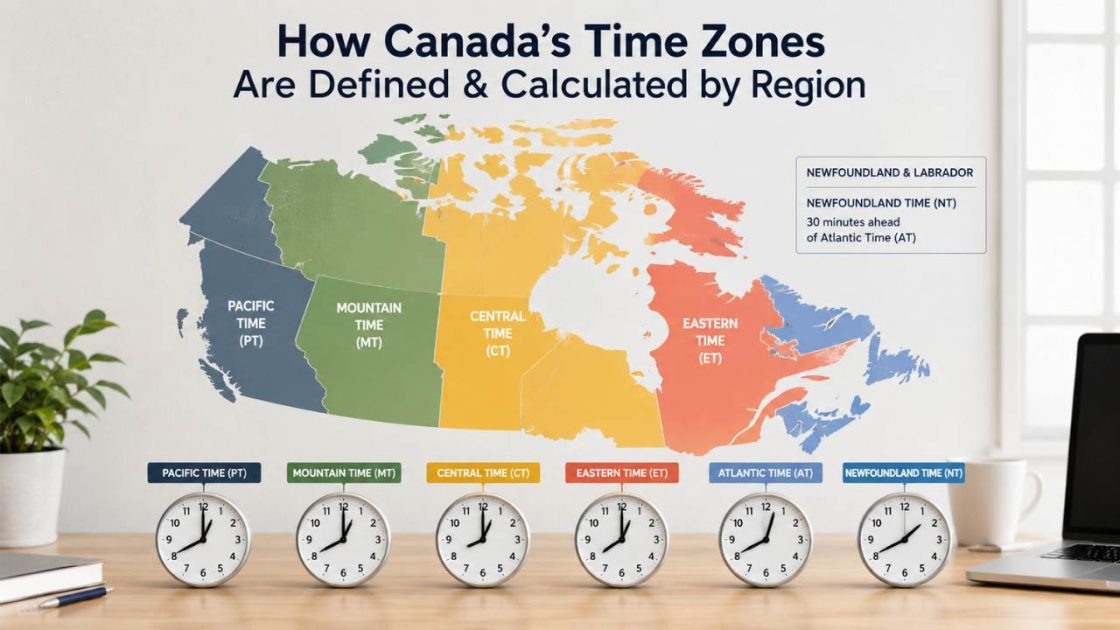
Canada officially spans six time zones, each defined by its UTC offset during standard (winter) time. To quickly understand the temporal layout of the country, refer to the standard baseline offsets below.
|
Time Zone |
Abbreviation |
Standard Time Offset (Winter) |
Daylight Saving Offset (Summer) |
Key Regions Covered |
|
Newfoundland |
NT |
UTC -3:30 |
UTC -2:30 |
Island of Newfoundland, SE Labrador |
|
Atlantic |
AT |
UTC -4:00 |
UTC -3:00 |
NS, NB, PEI, most of Labrador |
|
Eastern |
ET |
UTC -5:00 |
UTC -4:00 |
ON, QC, Eastern Nunavut |
|
Central |
CT |
UTC -6:00 |
UTC -5:00 |
MB, SK, Western Nunavut |
|
Mountain |
MT |
UTC -7:00 |
UTC -6:00 |
AB, NWT, Yukon (Year-round) |
|
Pacific |
PT |
UTC -8:00 |
UTC -7:00 |
Most of British Columbia |
Each zone represents a slice of the country where residents set their clocks to the same local time. The offset number tells you how many hours behind UTC that region operates during standard time, before any seasonal adjustments apply.
|
Time Zone |
Provinces / Territories |
Notable Exception |
|
Newfoundland |
Newfoundland Island and southeastern Labrador |
Uses a unique half-hour offset, uncommon in North America |
|
Atlantic |
Nova Scotia, New Brunswick, Prince Edward Island, and most of Labrador |
No major exceptions |
|
Eastern |
Ontario, Quebec, and eastern Nunavut |
Northwestern Ontario follows Central Time |
|
Central |
Manitoba, Saskatchewan, and western Nunavut |
Most of Saskatchewan does not observe Daylight Saving Time |
|
Mountain |
Alberta, the Northwest Territories, and parts of British Columbia and Nunavut |
No major exceptions |
|
Pacific |
Most of British Columbia and Yukon |
Yukon has remained on a fixed UTC−7 time since 2020 |
The island of Newfoundland and southeastern Labrador observe a rare half-hour offset. This arises from the region’s precise geographic position, which places it almost exactly midway between two standard hourly zones.
Nova Scotia, New Brunswick, Prince Edward Island, and most of Labrador follow Atlantic Time.
As one of Canada’s most economically and residentially dense zones, Eastern Time anchors the commercial hubs of the nation.
Central Time spans the vast prairie landscapes and parts of the northern territories.
It remains permanently on Central Standard Time year-round, serving as a rare anchor of chronological consistency in North America.
Mountain Time serves the western interior, encompassing majestic mountain landscapes and northern tundra.
Pacific Time forms Canada’s western coast boundary, looking out toward Asia-Pacific trade networks.
Most of Canada adjusts its clocks forward by one hour on the second Sunday of March and returns to standard time on the first Sunday of November.
Important Compliance Note!
Timekeeping is legislated at the provincial/territorial level, not federal. This is why seasonal time changes are not uniform across the map.
If geography dictated time zones, Canada would be neatly sliced by vertical lines every 15 degrees of longitude. In reality, boundaries follow highly irregular, zigzag tracks.
Provincial governments intentionally curve zone lines around natural barriers, economic trade networks, and municipal borders. Splitting a single small county or commuter town down the middle with two different clocks would disrupt school schedules, public transit, and local business operations. Historic railway routes from the 19th and 20th centuries also carved out paths that communities still honour today.
When navigating the Canadian immigration system, time zone accuracy is highly logistical.
The Immigration, Refugees and Citizenship Canada (IRCC) portals may calculate submission deadlines based on Eastern Time (Ottawa) or Coordinated Universal Time (UTC). Submitting a profile at 11:30 PM in Vancouver could technically mean it arrives past a midnight deadline in Ontario.
Legal consultations, employment interviews, and mandatory biometrics appointments are often anchored to where the official is located. If your immigration counsel is based in Toronto (ET) and you are landing in Calgary (MT), a 9:00 AM meeting means a 7:00 AM wake-up call for you.
Navigating the physical geography of Canada is just one piece of the puzzle—managing the legal steps to get here requires true precision. Book a consultation with Yameena Ansari at Ansari Immigration Law today and let our dedicated team ensure your timeline to Canadian permanent residency stays perfectly on track.
Yes! Most of Saskatchewan remains on Central Standard Time year-round. The Yukon also abolished seasonal shifts in 2020, permanently locking into Mountain Standard Time.
Newfoundland sits in a unique geographic location directly between two standard hourly meridians. To prevent daylight from feeling unnaturally out of sync with the sun, the local government established a split 30-minute offset (UTC -3:30) to perfectly match natural solar cycles.
Vancouver (Pacific Time) is exactly 3 hours behind Toronto (Eastern Time). Because both regions shift for daylight saving concurrently, this three-hour gap remains completely identical during both winter and summer months.
Yes! For example, while Ontario is predominantly Eastern Time, its westernmost communities near the Manitoba border observe Central Time. Similarly, parts of northeastern British Columbia operate on Mountain Time rather than Pacific Time to stay aligned with neighbouring Alberta business hubs.
Canada has six primary time zones: Newfoundland, Atlantic, Eastern, Central, Mountain, and Pacific. Each is calculated as a fixed offset from Coordinated Universal Time (UTC), ranging from UTC−3:30 in Newfoundland to UTC−8 on the Pacific coast. While longitude provides the foundation, provincial governments determine exact boundaries and daylight-saving Time rules.
Time zone boundaries in Canada are based on practical, economic, and political considerations rather than strict geographic lines. As a result, neighbouring regions may follow different time zones, while distant areas can share the same local time.
Understanding Canada’s time zones is essential for daily life, from scheduling appointments to communicating across provinces. They reflect not only geographic calculations but also historical decisions and the needs of communities across the country.