Trusted Canadian Immigration Lawyers
Planning to immigrate to Canada? Your language score could be the difference between approval and rejection. However, here’s what most Canadian immigration applicants may not know: it’s not just about passing the IELTS, TEF, or CELPIP. What truly matters is your CLB level.
Canadian immigration authorities don’t just look at raw scores; they convert them into Canadian Language Benchmark (CLB) scores. Miss the right CLB level and your dream of living in Canada could be delayed by months or even years.
So, what exactly is the CLB Language Test Chart, and how do your scores measure up? Let’s break everything down with Yameena Ansari, a trusted Canadian immigration legal advisor.
Content Table
The CLB is the official national standard used in Canada to measure English language proficiency for immigrants and prospective applicants. It plays a central role in evaluating your ability to live, work, and communicate effectively in the country.
It’s important to understand that CLB is not a test itself. Instead, it is a standardised framework used by Immigration, Refugees and Citizenship Canada (IRCC) to convert your scores from approved language tests, such as IELTS General Training, CELPIP General, or PTE Core, into a consistent scale.
The CLB system is divided into CLB 1 to CLB 12, grouped into three stages:
Each of the four key language skills is assessed separately:
This means your CLB level can vary across skills, for example, CLB 9 in Listening and CLB 7 in Writing, and both scores matter separately for your immigration application.
Your CLB level is one of the most important factors in your immigration journey. Here’s why:
Higher CLB levels significantly increase your Comprehensive Ranking System (CRS) score, improving your chances of receiving an Invitation to Apply (ITA).
Most immigration programs require minimum CLB levels:
Employers, licensing bodies, and educational institutions use CLB levels to assess whether your language skills meet their requirements.
To apply for Canadian citizenship, you must demonstrate at least CLB 4 in English or French.
Many applicants confuse CLB with the actual language tests. Here is a simple way to understand the difference:
|
Term |
What It Is |
|
IELTS |
An internationally recognised English language test |
|
CELPIP |
A Canadian-specific English language test |
|
TEF Canada |
A French language proficiency test for Canada |
|
CLB |
The benchmark scale that converts all test scores |
Think of CLB as the universal translator; no matter which test you take, your score gets converted into a CLB level that Canada uses to make fair and consistent decisions.
For French language proficiency, Canada uses a similar system called the Niveaux de compétence linguistique canadiens (NCLC). It follows the same 12-level structure as CLB.
One of the most common questions among Canadian immigration applicants is “How do I convert my test score into a CLB level?” The good news is that the conversion process is straightforward once you understand how it works. Let’s walk through each test one by one.
IELTS General Training is the most widely used English test for Canadian immigration. Here is how your IELTS band scores convert to CLB levels:
|
CLB Level |
Listening |
Reading |
Writing |
Speaking |
|
CLB 10 |
8.5 |
8 |
7.5 |
7.5 |
|
CLB 9 |
8 |
7 |
7 |
7 |
|
CLB 8 |
7.5 |
6.5 |
6.5 |
6.5 |
|
CLB 7 |
6 |
6 |
6 |
6 |
|
CLB 6 |
5.5 |
5 |
5.5 |
5.5 |
|
CLB 5 |
5 |
4 |
5 |
5 |
|
CLB 4 |
4.5 |
3.5 |
4 |
4 |
Legal Advice!
For Express Entry, you need a minimum of CLB 7 in all four skills, which means scoring at least 6.0 in every IELTS band.
CELPIP is a Canada-specific English test and is increasingly popular among applicants because it is designed with Canadian contexts in mind. The conversion is simpler since CELPIP scores align almost directly with CLB levels:
|
CLB Level |
Listening |
Reading |
Writing |
Speaking |
|
CLB 10 |
10 |
10 |
10 |
10 |
|
CLB 9 |
9 |
9 |
9 |
9 |
|
CLB 8 |
8 |
8 |
8 |
8 |
|
CLB 7 |
7 |
7 |
7 |
7 |
|
CLB 6 |
6 |
6 |
6 |
6 |
|
CLB 5 |
5 |
5 |
5 |
5 |
|
CLB 4 |
4 |
4 |
4 |
4 |
Legal Advice!
CELPIP is a computer-based test which many applicants find more convenient and less stressful than IELTS. If you are comfortable with computers, CELPIP could be your best option.
TEF Canada is the recognised French language proficiency test used for Canadian immigration. If you are applying through French-language immigration streams, your TEF scores convert to NCLC (Niveaux de compétence linguistique canadiens) levels, which is the French equivalent of CLB:
|
NCLC Level |
Listening |
Reading |
Writing |
Speaking |
|
NCLC 10 |
316–360 |
263–300 |
393–450 |
393–450 |
|
NCLC 9 |
298–315 |
248–262 |
371–392 |
371–392 |
|
NCLC 8 |
280–297 |
233–247 |
349–370 |
349–370 |
|
NCLC 7 |
249–279 |
207–232 |
310–348 |
310–348 |
|
NCLC 6 |
217–248 |
181–206 |
271–309 |
271–309 |
|
NCLC 5 |
181–216 |
151–180 |
226–270 |
226–270 |
|
NCLC 4 |
145–180 |
121–150 |
181–225 |
181–225 |
Legal Advice!
Scoring well in French language tests can give you a significant CRS points boost in Express Entry, sometimes more than English alone.
Not sure which test to take? Here is a quick comparison to help you decide:
|
Factor |
IELTS |
CELPIP |
TEF Canada |
|
Language |
English |
English |
French |
|
Format |
Paper & Computer |
Computer Only |
Paper & Computer |
|
Accepted For |
Express Entry, PNP, Study |
Express Entry, PNP |
Express Entry, PNP |
|
Test Duration |
~2 hours 45 min |
~3 hours |
~3 hours 30 min |
|
Results Time |
3–5 days |
4–5 days |
3–20 days |
|
Best For |
International applicants |
Canada-based applicants |
French stream applicants |
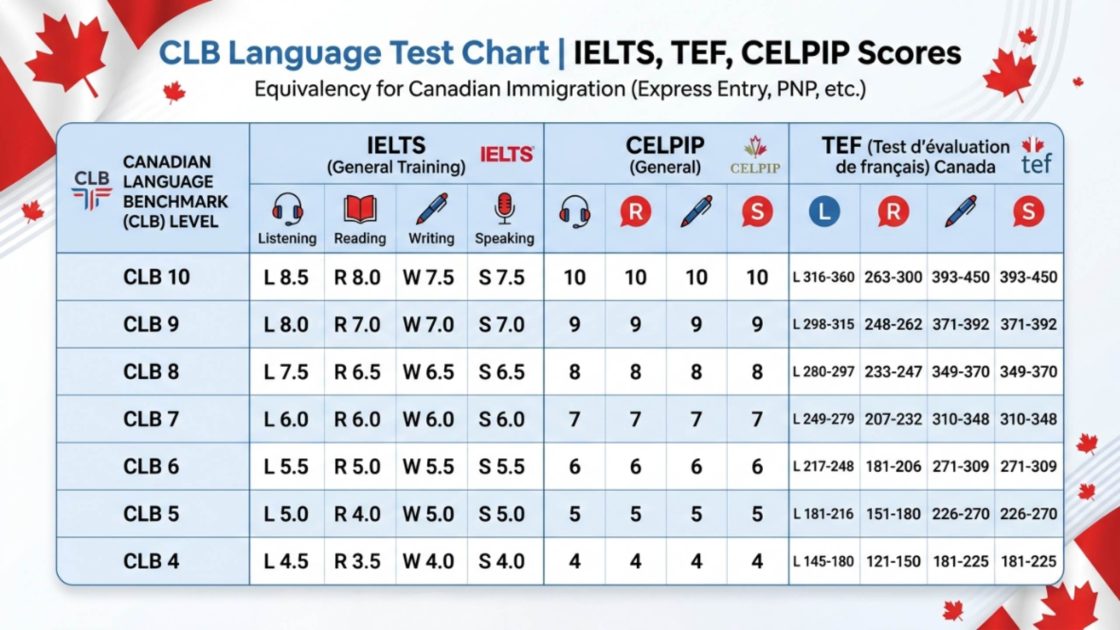
Now that you understand what CLB is and how scores are calculated, it is time to look at the complete CLB Language Test Chart, the most important reference tool for every Canadian immigration applicant. This chart brings together IELTS, CELPIP, and TEF scores side by side so you can instantly see where you stand.
Most applicants make the mistake of only checking their overall test score without understanding how each skill maps to a specific CLB level. This chart eliminates that confusion by giving you a clear, skill-by-skill breakdown across all three recognised tests.
|
CLB / NCLC Level |
IELTS |
CELPIP |
TEF Canada |
|
CLB 12 |
9 |
12 |
349–360 |
|
CLB 11 |
8.5 |
11 |
331–348 |
|
CLB 10 |
8.5 |
10 |
316–330 |
|
CLB 9 |
8 |
9 |
298–315 |
|
CLB 8 |
7.5 |
8 |
280–297 |
|
CLB 7 |
6 |
7 |
249–279 |
|
CLB 6 |
5.5 |
6 |
217–248 |
|
CLB 5 |
5 |
5 |
181–216 |
|
CLB 4 |
4.5 |
4 |
145–180 |
|
CLB / NCLC Level |
IELTS |
CELPIP |
TEF Canada |
|
CLB 12 |
9 |
12 |
279–300 |
|
CLB 11 |
8.5 |
11 |
263–278 |
|
CLB 10 |
8 |
10 |
248–262 |
|
CLB 9 |
7 |
9 |
233–247 |
|
CLB 8 |
6.5 |
8 |
207–232 |
|
CLB 7 |
6 |
7 |
181–206 |
|
CLB 6 |
5 |
6 |
151–180 |
|
CLB 5 |
4 |
5 |
121–150 |
|
CLB 4 |
3.5 |
4 |
121–150 |
|
CLB / NCLC Level |
IELTS |
CELPIP |
TEF Canada |
|
CLB 12 |
9 |
12 |
421–450 |
|
CLB 11 |
8.5 |
11 |
407–420 |
|
CLB 10 |
7.5 |
10 |
393–406 |
|
CLB 9 |
7 |
9 |
371–392 |
|
CLB 8 |
6.5 |
8 |
349–370 |
|
CLB 7 |
6 |
7 |
310–348 |
|
CLB 6 |
5.5 |
6 |
271–309 |
|
CLB 5 |
5 |
5 |
226–270 |
|
CLB 4 |
4 |
4 |
181–225 |
|
CLB / NCLC Level |
IELTS |
CELPIP |
TEF Canada |
|
CLB 12 |
9 |
12 |
421–450 |
|
CLB 11 |
8.5 |
11 |
407–420 |
|
CLB 10 |
7.5 |
10 |
393–406 |
|
CLB 9 |
7 |
9 |
371–392 |
|
CLB 8 |
6.5 |
8 |
349–370 |
|
CLB 7 |
6 |
7 |
310–348 |
|
CLB 6 |
5.5 |
6 |
271–309 |
|
CLB 5 |
5 |
5 |
226–270 |
|
CLB 4 |
4 |
4 |
181–225 |
Using this chart is straightforward. Follow these simple steps to understand your CLB level accurately:
To make things even simpler, here is how CLB levels are generally grouped:
|
CLB Range |
Proficiency Level |
What It Means |
|
CLB 1–4 |
Basic |
Beginner level — limited communication ability |
|
CLB 5–8 |
Intermediate |
Functional communication for everyday tasks |
|
CLB 9–10 |
Advanced |
Strong professional communication skills |
|
CLB 11–12 |
Mastery |
Near native or native level proficiency |
|
Immigration Program |
Minimum CLB Required |
|
Federal Skilled Worker (FSW) |
CLB 7 in all four skills |
|
Canadian Experience Class (CEC) |
CLB 7 (NOC TEER 0/1) or CLB 5 (NOC TEER 2/3) |
|
Federal Skilled Trades (FST) |
CLB 5 Speaking & Listening / CLB 4 Reading & Writing |
|
Provincial Nominee Programs (PNP) |
CLB 4 to CLB 7, depending on the province |
|
Atlantic Immigration Program (AIP) |
CLB 4 to CLB 6, depending on occupation |
|
Rural and Northern Immigration Pilot |
CLB 4 to CLB 7, depending on the stream |
|
Canadian Citizenship |
CLB 4 minimum |
Important Reminder!
This CLB Language Test Chart is based on the latest guidelines from Immigration, Refugees and Citizenship Canada (IRCC). However, requirements can change over time. Always verify the minimum CLB requirements directly on the official IRCC website before submitting your immigration application.
Now that you have your CLB level in hand, the next critical question is, “Is my CLB level good enough to immigrate to Canada?” The answer depends entirely on which immigration pathway you are targeting. Different programs have different minimum requirements, and understanding them clearly can save you months of wasted time and effort.
Before diving into specific programs, remember this one rule:
Your CLB level is only as strong as your weakest skill. Even if you score CLB 9 in Listening and Speaking but CLB 6 in Writing, your effective CLB level for most programs will be considered CLB 6. Every single skill matters equally.
The Federal Skilled Worker Program is one of the most popular immigration pathways for skilled professionals worldwide.
|
Skill |
Minimum CLB Requirement |
|
Listening |
CLB 7 |
|
Reading |
CLB 7 |
|
Writing |
CLB 7 |
|
Speaking |
CLB 7 |
What this means in real scores:
Bonus Points: Scoring CLB 9 or above in all four skills adds 50 additional CRS points to your Express Entry profile, significantly boosting your chances of receiving an ITA.
The Canadian Experience Class is designed for those who already have skilled work experience in Canada. CLB requirements vary based on your NOC TEER category:
|
NOC TEER Category |
Minimum CLB Required |
|
TEER 0 or TEER 1 occupations |
CLB 7 in all four skills |
|
TEER 2 or TEER 3 occupations |
CLB 5 in all four skills |
Important Note! If you have work experience in both TEER categories, the higher CLB requirement of CLB 7 will apply to your application.
The Federal Skilled Trades Program has slightly different CLB requirements depending on the skill being evaluated:
|
Skill |
Minimum CLB Requirement |
|
Listening |
CLB 5 |
|
Speaking |
CLB 5 |
|
Reading |
CLB 4 |
|
Writing |
CLB 4 |
Pro Tip: The FSTP has lower language requirements compared to FSWP and CEC, making it an excellent pathway for skilled tradespeople who may not have the highest language scores.
Each Canadian province has its own Provincial Nominee Program with unique CLB requirements. Here is a general overview:
|
Province |
Stream |
Minimum CLB |
|
Ontario (OINP) |
Human Capital Priorities |
CLB 7 |
|
British Columbia (BC PNP) |
Skilled Worker |
CLB 4 |
|
Alberta (AINP) |
Alberta Opportunity Stream |
CLB 5 |
|
Saskatchewan (SINP) |
International Skilled Worker |
CLB 4 |
|
Manitoba (MPNP) |
Skilled Worker in Manitoba |
CLB 5 |
|
Nova Scotia (NSNP) |
Skilled Worker Stream |
CLB 7 |
|
New Brunswick (NBPNP) |
Skilled Worker Stream |
CLB 6 |
Legal Advice!
If your CLB level does not meet Express Entry requirements, provincial nominee programs with lower CLB thresholds can be an excellent alternative pathway to Canadian permanent residence.
The Atlantic Immigration Program covers four Atlantic provinces: Nova Scotia, New Brunswick, Prince Edward Island, and Newfoundland and Labrador.
|
Occupation Type |
Minimum CLB Required |
|
High-skilled occupations (TEER 0, 1, 2, 3) |
CLB 6 |
|
Intermediate occupations (TEER 4) |
CLB 4 |
The Rural and Northern Immigration Pilot helps smaller Canadian communities attract skilled workers. CLB requirements depend on the occupation:
|
Occupation Type |
Minimum CLB Required |
|
High-skilled occupations |
CLB 6 |
|
Intermediate-skilled occupations |
CLB 5 |
|
Lower-skilled occupations |
CLB 4 |
Even after obtaining permanent residence, you will need to demonstrate language ability when applying for Canadian citizenship:
|
Requirement |
Minimum CLB Level |
|
English or French proficiency |
CLB 4 in all four skills |
Your language score is one of the biggest contributors to your overall CRS score. Here is how CLB levels translate into CRS points for the first official language:
|
CLB Level |
CRS Points (No Spouse) |
CRS Points (With Spouse) |
|
CLB 10 or higher |
34 per skill (136 total) |
32 per skill (128 total) |
|
CLB 9 |
31 per skill (124 total) |
29 per skill (116 total) |
|
CLB 8 |
23 per skill (92 total) |
22 per skill (88 total) |
|
CLB 7 |
17 per skill (68 total) |
16 per skill (64 total) |
|
CLB 6 |
9 per skill (36 total) |
8 per skill (32 total) |
|
CLB 5 |
6 per skill (24 total) |
6 per skill (24 total) |
|
CLB 4 |
6 per skill (24 total) |
6 per skill (24 total) |
Key Insight! Moving from CLB 7 to CLB 9 can add up to 56 additional CRS points to your profile, which could be the difference between receiving an ITA or waiting indefinitely in the Express Entry pool.
Use this simple guide to instantly know if your CLB level qualifies:
|
Your CLB Level |
You Are Eligible For |
|
CLB 4 |
Citizenship, some PNP streams, FSTP Reading & Writing |
|
CLB 5 |
FSTP, AIP intermediate, RNIP lower-skilled, some PNP streams |
|
CLB 6 |
AIP high-skilled, RNIP intermediate, most PNP streams |
|
CLB 7 |
FSWP, CEC TEER 0/1, Ontario PNP, Nova Scotia PNP |
|
CLB 8 and above |
All programs plus a strong CRS score boost |
|
CLB 9 and above |
Maximum CRS language points — strongest competitive profile. |
Do not panic. Here is what you can do:
So, your CLB level is not quite where it needs to be; do not worry. Thousands of successful Canadian immigrants have been in exactly the same position. The difference between those who made it and those who did not comes down to one thing: a smart, targeted preparation strategy. Here are the most effective tips to boost your CLB score before you apply.
The biggest mistake applicants make is studying everything equally. Instead, follow this simple approach:
Remember!
Improving just one weak skill from CLB 6 to CLB 7 could unlock Express Entry eligibility and add dozens of CRS points to your profile.
Listening is often the skill applicants underestimate the most; yet it is one of the easiest to improve with consistent daily practice.
Quick Win!
Spending just 30 minutes daily listening to Canadian English content can show noticeable improvement in as little as four weeks.
Reading requires both speed and comprehension; two skills that need to be developed simultaneously for a high CLB score.
Quick Win!
Reading one full article daily from a Canadian newspaper and summarising it in writing combines reading and writing practice, saving you double the preparation time.
Writing is the skill that requires the most structured practice and is often where applicants lose the most marks due to grammar errors and poor organisation.
Quick Win!
Writing one timed practice response daily and comparing it against a model answer is the single most effective writing improvement strategy available.
Speaking is the skill that causes the most anxiety among test takers, but it is also the skill where consistent daily practice shows the fastest results.
Quick Win!
Recording a two-minute spoken response to a practice question daily and reviewing it for fluency and coherence is the fastest way to build speaking confidence.
Beyond individual skill improvement, here are some powerful general strategies that will accelerate your overall CLB score improvement:
The honest answer depends on your starting point and how consistently you practice, but here is a general timeline most applicants experience:
|
Starting CLB Level |
Target CLB Level |
Estimated Preparation Time |
|
CLB 4 |
CLB 6 |
4 to 6 months |
|
CLB 5 |
CLB 7 |
3 to 5 months |
|
CLB 6 |
CLB 7 |
6 to 10 weeks |
|
CLB 7 |
CLB 9 |
2 to 4 months |
|
CLB 8 |
CLB 9 |
4 to 8 weeks |
Important!
These are estimates based on consistent daily practice of 45 to 60 minutes. Results vary based on individual learning pace, prior language exposure, and the quality of study materials used.
Beyond strategies and study tips, the applicants who improve their CLB scores the fastest share one common trait: they treat language improvement as a daily lifestyle, not just exam preparation. Immerse yourself in English or French as much as possible:
The more naturally the language flows in your daily life, the more naturally it will flow in your test, and the higher your CLB level will be.
Immigration decisions are too important to leave to guesswork. Whether you are just starting out or already preparing your application, Ansari Immigration Law provides trusted legal guidance every step of the way.
From understanding your CLB level to selecting the right program and submitting a winning application, we are with you from start to finish. Contact us today for a professional consultation and allow a legal expert to evaluate your CLB score.
No! Canadian immigration programs specifically require IELTS General Training, not IELTS Academic. Ensure you register for the correct test version to avoid having your application rejected.
All language test results are valid for two years from the date of the test. After two years, your scores expire, and you will need to retake the test if you have not yet submitted your immigration application.
No! You must submit scores from a single test sitting for all four skills. You cannot combine IELTS Listening with CELPIP Speaking, for example. All four skills must come from the same test and the same test date.
If your test scores expire after you have already submitted a complete application to IRCC, they will generally still be accepted. However, if you have not yet submitted your application, you will need to retake the test before applying.
There is no limit to how many times you can take IELTS, CELPIP, or TEF. You can retake the test as many times as needed and submit your best result for your immigration application.
No! French is not mandatory unless you are applying through a French-language immigration stream. However, taking TEF Canada and achieving a strong French score can add significant bonus CRS points to your Express Entry profile even if English is your primary language.
Neither test is objectively easier than the other — it depends entirely on your individual strengths and comfort level. CELPIP is fully computer-based and uses Canadian contexts, which some applicants find more relatable. IELTS offers both paper and computer formats and is more internationally recognised. Try a free practice test for both before deciding which one to take.
CLB (Canadian Language Benchmarks) is the framework used for English language proficiency, while NCLC (Niveaux de compétence linguistique canadiens) is the equivalent framework used for French language proficiency. Both follow the same scale from level 1 to level 12 and are used by IRCC to evaluate language ability for Canadian immigration.
Understanding the CLB language test chart is crucial because immigration decisions are based on CLB levels—not raw test scores. For example, achieving CLB 7 (such as IELTS 6.0 in each band) is the minimum requirement for programs like the Federal Skilled Worker stream.
Even small improvements can make a big difference. Moving from CLB 7 to CLB 9 can add up to 50+ CRS points, significantly increasing your chances of receiving an Invitation to Apply and strengthening your overall profile.
In the end, accurate score conversion, targeted preparation, and meeting program-specific CLB thresholds are key. Always check the latest requirements and aim higher than the minimum to stay competitive and avoid delays.
Share This Guide!
If you found this CLB Language Test Chart guide helpful, please share it with friends and family who are also planning to immigrate to Canada.
Disclaimers!
This guide is intended for informational purposes only and does not constitute legal or immigration advice. Always consult a licensed Regulated Canadian Immigration Consultant (RCIC) or Canadian immigration lawyer for advice specific to your individual situation. Immigration policies and CLB requirements are subject to change, always verify information on the official IRCC website before applying.