Trusted Canadian Immigration Lawyers
Planning to immigrate to Canada but unsure whether your language scores are strong enough? You are not alone. Thousands of applicants every year submit their applications without fully understanding the difference between CLB 5 and CLB 7, and that single gap can determine whether your application is approved, delayed, or rejected entirely.
In this guide, we break down exactly what CLB 5 and CLB 7 mean, how your IELTS, CELPIP, PTE Core, TEF Canada, and TCF Canada scores align with these benchmarks, and which immigration programs require each level. Let’s learn straight in.
The CLB is Canada’s official national standard for measuring English language proficiency. It is not a test; it is a 12-level framework used by Immigration, Refugees and Citizenship Canada (IRCC) to convert your approved language test scores into a consistent, comparable scale. Each stage evaluates four core language skills separately:
The CLB scale is divided into three stages:
|
Stage |
CLB Range |
Proficiency Level |
|
Stage I |
CLB 1–4 |
Basic: Everyday simple communication |
|
Stage II |
CLB 5–8 |
Intermediate: Moderately complex communication |
|
Stage III |
CLB 9–12 |
Advanced: Professional and academic communication |
Important!
Your CLB level determines skill by skill. A strong score in one area cannot compensate for a weak score in another; every skill must meet the minimum requirement of your target immigration program.
Both CLB 5 and CLB 7 fall within Stage II: Intermediate Language Ability. However, there is a meaningful difference between the two levels that directly impacts your immigration eligibility.
|
Language Skill |
CLB 5 |
CLB 7 |
|
Listening |
Can interpret moderately complex spoken communication with some difficulty |
Handles moderately complex spoken communication adequately in most contexts |
|
Speaking |
Creates moderately complex spoken responses but may struggle in unfamiliar situations |
Communicates clearly and adequately in most everyday and professional contexts |
|
Reading |
Interprets moderately complex written texts with occasional difficulty |
Reads and understands moderately complex written material with confidence |
|
Reading |
Produces moderately complex written communication with noticeable limitations |
Creates clear, organised written communication suitable for workplace contexts |
In Simple Terms!
CLB 5 is where intermediate proficiency begins, while CLB 7 is where it becomes reliable and competitive for most Canadian immigration programs.
For French language proficiency, Canada uses the Niveaux de compétence linguistique canadiens (NCLC), a parallel 12-level framework that mirrors the CLB structure exactly. NCLC 5 is the French equivalent of CLB 5, and NCLC 7 is the French equivalent of CLB 7.
If you are applying through a French-language immigration stream, your NCLC level carries the same weight as CLB does for English applicants.
Canada accepts five approved language tests for immigration, study, and work permit applications. You must take the correct version of each test; submitting the wrong test type can result in your application being rejected.
Pro Tip!
If you want to demonstrate proficiency in both English and French, you must take one approved test from each list. A strong French score alongside your English results can add significant bonus CRS points to your Express Entry profile.
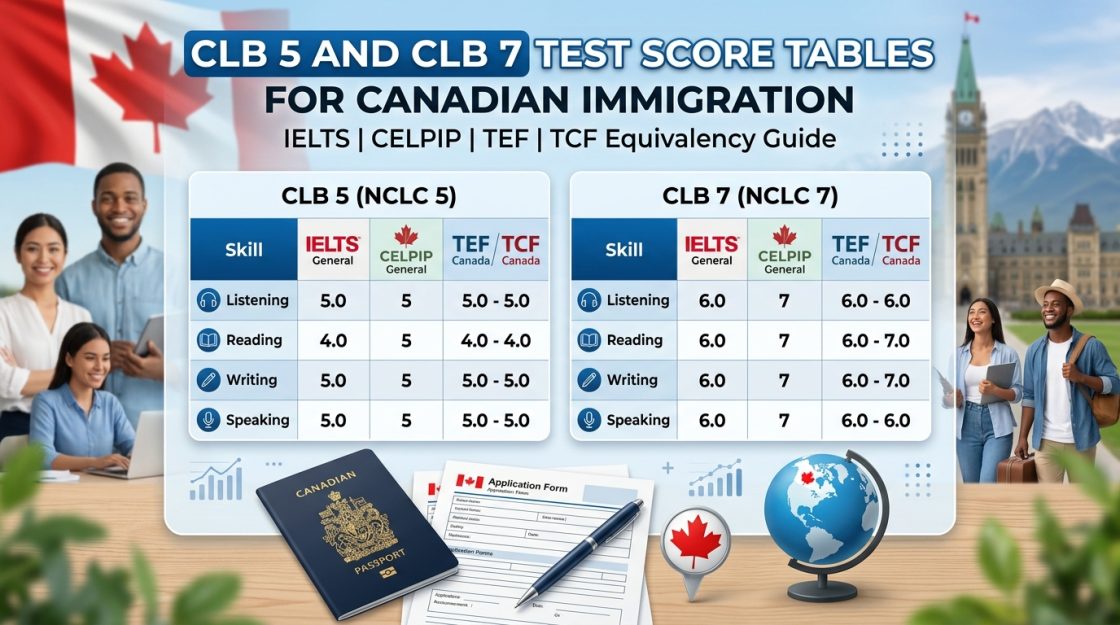
The table below shows the exact scores required to achieve CLB 5 across all five approved language tests:
|
Test |
Listening |
Speaking |
Reading |
Writing |
|
IELTS General Training |
5 |
5 |
4 |
5 |
|
CELPIP General |
5 |
5 |
5 |
5 |
|
PTE Core |
39–49 |
51–58 |
42–50 |
51–59 |
|
TEF Canada |
181–216 |
226–270 |
151–180 |
226–270 |
|
TCF Canada |
369–397 |
637–405 |
6 |
6 |
CLB 5 represents the entry point of intermediate proficiency and is the minimum requirement for several Canadian immigration programs, including certain Provincial Nominee Program streams, the Federal Skilled Trades Program for Reading and Writing skills, and some Rural and Northern Immigration Pilot streams.
The table below shows the exact scores required to achieve CLB 7 across all five approved language tests:
|
Test |
Listening |
Speaking |
Reading |
Writing |
|
IELTS General Training |
6 |
6 |
6 |
6 |
|
CELPIP General |
7 |
7 |
7 |
7 |
|
PTE Core |
60–70 |
68–75 |
60–68 |
69–78 |
|
TEF Canada |
249–279 |
310–348 |
207–232 |
310–348 |
|
TCF Canada |
458–502 |
210–114 |
53–498 |
10–11 |
CLB 7 is the most critical benchmark for Canadian immigration. It is the minimum language requirement for the Federal Skilled Worker Program, the Canadian Experience Class for TEER 0 and TEER 1 occupations, and many Provincial Nominee Programs (PNP) across Canada.
Key Insight!
The gap between CLB 5 and CLB 7 on IELTS is just 1.0 band point in most skills, but that single point unlocks access to Canada’s most competitive and sought-after immigration programs.
|
Immigration Program |
CLB 5 |
CLB 7 |
|
Federal Skilled Worker Program |
✗ Not eligible |
✓ Required (all four skills) |
|
Canadian Experience Class (TEER 0/1) |
✗ Not eligible |
✓ Required (all four skills) |
|
Canadian Experience Class (TEER 2/3) |
✓ Minimum requirement |
✗ Not required |
|
Federal Skilled Trades (Speaking & Listening) |
✓ Minimum requirement |
✗ Not required |
|
Federal Skilled Trades (Reading & Writing) |
✗ CLB 4 sufficient |
✗ Not required |
|
Provincial Nominee Programs |
✓ Some streams |
✓ Most competitive streams |
|
Atlantic Immigration Program |
✓ Intermediate occupations |
✓ High-skilled occupations |
|
Rural & Northern Immigration Pilot |
✓ Lower-skilled streams |
✓ Higher-skilled streams |
PTE Core is accepted for Express Entry programs, including the Federal Skilled Worker Program, Canadian Experience Class, and Federal Skilled Trades Program, as well as most Provincial Nominee Programs. However always confirm acceptance with the specific program you are applying to, as requirements can vary by province and stream.
Your effective CLB level for program eligibility is determined by your lowest-scoring skill. If one skill scores CLB 5 while the others reach CLB 7, your application will be evaluated at CLB 5 for that skill. This means you would not meet the CLB 7 minimum required for programs like the Federal Skilled Worker Program until all four skills reach CLB 7.
For IELTS and CELPIP, you must retake the full test; partial retakes are not accepted for Canadian immigration purposes. It is also important to note that IRCC does not accept IELTS One Skill Retake results for Express Entry applications. PTE Core similarly requires a full sitting for immigration submissions.
CLB 7 meets the language requirement for Express Entry programs like the Federal Skilled Worker Program, but language is just one eligibility factor. You must also meet education, work experience, and adaptability requirements. Meeting CLB 7 is an essential step, but not the only one needed for a complete and competitive Express Entry profile.
Both English CLB 5 and French NCLC 5 contribute to your CRS score but the points are calculated differently depending on whether it is your first or second official language. Strong French scores alongside English results can earn you significant bonus CRS points that could push your profile above the minimum cutoff for Express Entry draws.
All approved language test results, IELTS, CELPIP, PTE Core, TEF Canada, and TCF Canada, are valid for two years from the test date. If your scores expire before you submit your application, you will need to retake the test. Plan your test date strategically to ensure your results remain valid throughout your entire application process.
Both TEF Canada and TCF Canada are accepted French language tests for Canadian immigration, but they are administered by different organisations and use different scoring systems. TEF Canada is offered by the French Chamber of Commerce, while TCF Canada is offered by France Éducation International. Both assess the same four language skills, and both convert to NCLC levels. The choice between them largely comes down to personal preference and test availability in your region.
No! Meeting the minimum CLB 5 requirement for a PNP stream makes you eligible to apply, but does not guarantee a nomination. Provincial Nominee Programs are competitive and assess multiple factors, including work experience, education, job offers, and ties to the province, alongside language scores. A higher CLB level than the minimum will always strengthen your overall nomination application.
Understanding the difference between CLB 5 and CLB 7 is not just academic; it is one of the most practical steps you can take to protect your immigration timeline and maximise your chances of success.
CLB 5 opens doors to several Canadian immigration pathways, but CLB 7 is where the most competitive and rewarding programs become accessible. If your current scores place you at CLB 5, you are closer to CLB 7 than you might think; in many cases, just one band point on IELTS or one level on CELPIP separates you from a significantly stronger immigration profile.
Know your scores. Know your target. And if you are unsure where to start, speak with a qualified immigration legal advisor who can map out the fastest and most effective route to your Canadian goals.