Trusted Canadian Immigration Lawyers
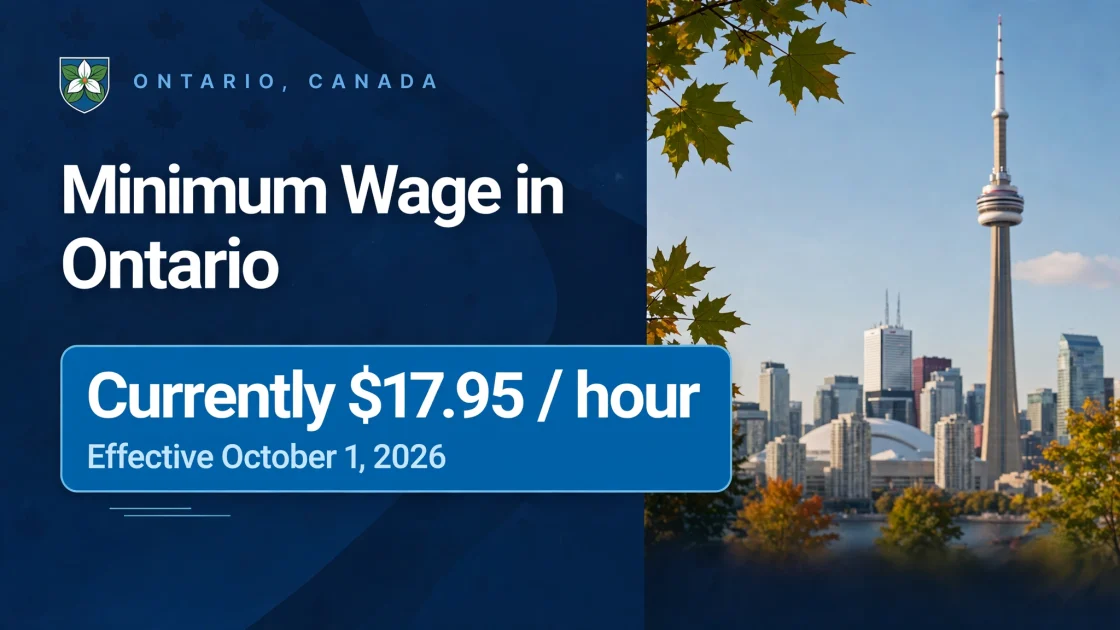
As of September 25, 2026, the general minimum wage in Ontario is $17.60 per hour. On October 1, 2026, it will increase to $17.95. However, the rate you are entitled to may vary depending on your age, occupation, and type of employment.
Ontario has different minimum wage rates for certain students, homeworkers, and wilderness guides. Federally regulated employees may also follow a separate federal minimum wage. Understanding which rate applies can help you check whether your pay meets legal standards.
This guide from Ansari Immigration Law explains Ontario minimum wage rates for 2026 and the October 1 increase. It covers student and homeworker rates, overtime, the three hour rule, and steps to take after underpayment. Also explains how these employment rules can affect newcomers, international students, and temporary foreign workers.
The table below sets out the main Ontario minimum wage rates and the rates taking effect October 1, 2026.
|
Rate Category |
Current Rate (to Sept 30, 2026) |
Effective Oct 1, 2026 |
Who It Generally Covers |
|
General minimum wage |
$17.60 per hour |
$17.95 per hour |
Most employees covered by Ontario’s Employment Standards Act |
|
Student minimum wage |
$16.60 per hour |
$16.90 per hour |
Students under 18 working limited hours during the school year or during school holidays |
|
Homeworker minimum wage |
$19.35 per hour |
$19.70 per hour |
Employees who do paid work for an employer from their own home |
|
Hunting, fishing and wilderness guide (under five hours a day) |
$88.05 per day |
$89.75 per day |
Guides working less than five consecutive hours in a day |
|
Hunting, fishing and wilderness guide (five or more hours a day) |
$176.15 per day |
$179.50 per day |
Guides working five or more hours in a day |
Ontario eliminated its separate liquor server rate in 2022. Employees who serve food or alcohol are now covered by the applicable general or student minimum wage rather than a lower server specific rate.
The current general Ontario minimum wage is $17.60 per hour, applying from October 1, 2025 through September 30, 2026. It rises to $17.95 per hour on October 1, 2026, for the period running to September 30, 2027. These exact dates matter, since pay periods straddling October 1 need to reflect the correct rate for each portion of hours worked.
Ontario’s minimum wage does not increase randomly each year. The province uses an indexation system to adjust wages based on changes in the cost of living.
For a full year, that increase could add roughly $728 before deductions. Understanding the reason behind the adjustment makes it easier to track upcoming wage changes.
The Employment Standards Act sets minimum wage protections for most employees, regardless of how they are paid. This generally includes:
That said, not every worker is covered the same way. Certain independent contractors, volunteers, federally regulated employees, diplomats, inmates, police officers, judges and some specific occupations fall under exemptions. Whether someone is truly an employee or an independent contractor depends on the actual working relationship, not simply the label a contract uses.
The Ontario student minimum wage applies only in specific situations. It generally covers students under 18 who work 28 hours or less each week during the school term. The rate can also apply when they work during school holidays, including summer, winter, or March breaks.
Being a student does not automatically mean the lower rate applies. Students aged 18 or older generally receive the general minimum wage. An under 18 student who works more than 28 hours weekly during the school term is also generally entitled to the general rate.
A homeworker is an employee who performs paid work for an employer from their own home. Ontario provides this category with a higher minimum wage than the general employee rate.
The current homeworker minimum wage is $19.35 per hour. It will increase to $19.70 on October 1, 2026. This category can include employees completing tasks such as garment production or data entry at home under an employer’s direction.
Getting paid a salary or commission does not automatically remove your right to minimum wage. Ontario employment standards can protect employees under different pay arrangements, depending on the hours worked and applicable rules.
Receiving a fixed salary does not remove an employee’s minimum wage protection. Employers still need to confirm that the effective hourly rate, based on actual hours worked, meets or exceeds the applicable minimum wage. A salaried employee who regularly works long hours must still receive wages that meet the applicable minimum wage requirements based on hours worked, subject to applicable exemptions.
The same principle applies to commission based pay. An employee paid fully or partly by commission must still receive at least the applicable minimum wage for hours worked. For example, an employee working 40 hours at the current $17.60 rate must receive at least $704 total for that week, whether from commission, a base amount, or both. The exact calculation depends on the pay arrangement and applicable rules.
Overtime pay in Ontario is generally triggered after 44 hours worked in a single work week, not simply because someone works a long shift on one particular day. Once the 44 hour threshold is crossed, the employee is generally entitled to at least one and a half times their regular rate, subject to exemptions, special rules and valid averaging agreements.
Using the current general minimum wage, the basic overtime rate works out to $26.40 per hour. From October 1, 2026, at $17.95 per hour, it becomes approximately $26.93 per hour.
The three hour rule can apply when an employee who regularly works more than three hours a day is scheduled for a shift, reports to work as required, and is then given less than three hours of work. The employee may be entitled to pay for three hours at the applicable minimum wage, subject to certain exceptions in the Employment Standards Act.
For example, an employee normally working longer shifts who is sent home after just one hour may be entitled to three hours of pay. At the current $17.60 rate, that works out to $52.80, even though only one hour was actually worked.
If your pay appears below Ontario’s legal minimum, start by checking your records and understanding how your wages were calculated. Taking a few clear steps can help you identify a potential underpayment and decide what to do next.
Many straightforward underpayment issues resolve directly with an employer or through a standard claim, so not every situation needs a certified lawyer in the UK.
This is an area where employment standards and immigration status often get confused, so it is worth being precise. Ontario minimum wage protections generally apply to international students, temporary foreign workers and other work permit holders the same way they apply to citizens and permanent residents. Immigration status does not let an employer pay below the applicable minimum wage.
At the same time, employment standards and immigration eligibility are legally separate matters. Being paid minimum wage does not by itself qualify someone for an immigration program. Employment records such as pay stubs, contracts and work history can help document Canadian employment when an immigration application requires proof of qualifying work experience. Whether particular employment counts depends on the requirements of the immigration programme or pathway.
Newcomers considering a transition from temporary status to permanent residence can review Temporary to Permanent Residency: Canada’s Top Transition Pathways for an overview of available pathways.
Those still seeking lawful employment can also explore guidance on finding a job in Canada as a foreigner. Anyone working under a Canadian work permit benefits from understanding these baseline protections.
Most Ontario employees are covered by the provincial Employment Standards Act, but a smaller group fall under federal jurisdiction, including banking, air transportation, interprovincial transportation, postal and courier services, and telecommunications and broadcasting, and follow the Canada Labour Code instead.
The federal minimum wage increased to $18.15 per hour on April 1, 2026. Federally regulated employees are entitled to the higher of the federal minimum wage and the applicable provincial or territorial minimum wage.
Ontario does not set separate municipal minimum wage rates for Toronto, London, Ottawa, Mississauga, Brampton or any other city. The provincial rate applies consistently across the entire province, subject to the categories and exemptions already described, since no city specific minimum wage exists under current Ontario law.
|
Date |
What Happens |
|
April 1 each year |
The Ontario government publishes the minimum wage rates that will apply from the following October 1 |
|
September 30, 2026 |
The current rate period ends |
|
October 1, 2026 |
New Ontario minimum wage rates take effect, including the $17.95 general rate |
|
September 30, 2027 |
The 2026 to 2027 rate period ends |
|
October 1, 2027 |
The next annual adjustment is expected to take effect, based on the rate the Ontario government officially publishes by April 1, 2027 |
Understanding Ontario minimum wage rules is one part of building a stable working life here, and for many newcomers that working life is closely tied to immigration status. Ansari Immigration Law helps clients see how documented employment fits into study to work transitions and permanent residence planning.
If your work connects to a permit, temporary residence, or your next immigration step, our team can help you understand what documentation matters. Explore your options for immigration to Canada.
The general minimum wage in Ontario is $17.60 per hour from October 1, 2025 to September 30, 2026. It increases to $17.95 per hour on October 1, 2026, for the following twelve month period.
The next increase takes effect on October 1, 2026, when the general rate moves from $17.60 to $17.95 per hour. Ontario reviews and publishes its minimum wage rates every April 1 based on the provincial Consumer Price Index.
Students under 18 who work 28 hours a week or less while school is in session, or who work during a school holiday, generally receive $16.60 per hour, rising to $16.90 on October 1, 2026. Students 18 or older generally receive the full general rate.
Homeworkers, meaning employees who perform paid work from their own home for an employer, currently receive at least $19.35 per hour, increasing to $19.70 per hour on October 1, 2026.
Yes! A fixed salary does not remove minimum wage protection. The effective hourly rate, based on actual hours worked, must still meet or exceed the applicable minimum wage under Ontario law.
Overtime generally applies after 44 hours worked in a single work week, at a rate of at least one and a half times the employee’s regular rate, subject to exemptions and any valid averaging agreements.
Keep your pay stubs and hours worked, raise the issue with your employer, and consider filing an Employment Standards Claim with the Ontario Ministry of Labour if the matter is not resolved directly.
Yes! Ontario minimum wage protections generally apply regardless of immigration status. A work permit or study permit does not reduce a worker’s entitlement to the applicable minimum wage, though wage compliance and immigration eligibility remain separate questions, and firms such as Ansari Immigration Law can help when the two intersect.
Ontario’s minimum wage rules affect more than the hourly rate shown on a paycheque. As of September 25, 2026, the general rate is $17.60 per hour, increasing to $17.95 on October 1. Students, homeworkers and wilderness guides may fall under different rates, while federally regulated employees follow federal rules.
Understanding overtime, salary, commission pay and the three hour rule can help workers identify whether their compensation meets legal requirements. For newcomers, international students and temporary foreign workers, knowing these protections is equally important. Employment standards apply separately from immigration requirements.
However, accurate pay stubs, working hour records and employment documents can support clearer records of Canadian work experience. Anyone concerned about unpaid wages or employment conditions should review the rules and seek legal advice for complex cases.
Disclaimer: This article is for general informational purposes only and does not constitute legal advice. Employment standards and immigration requirements can change, so readers should verify current government requirements or seek professional legal advice for their individual circumstances.